 01/10/2026
Demystifying Agile and Scrum: Philosophy vs Execution
In software development, "Agile" and "Scrum" are often used interchangeably. Founders and stakeholders frequently say, "We are doing Agile sprints," blurring the line between a philosophical mindset and a rigid procedural framework.
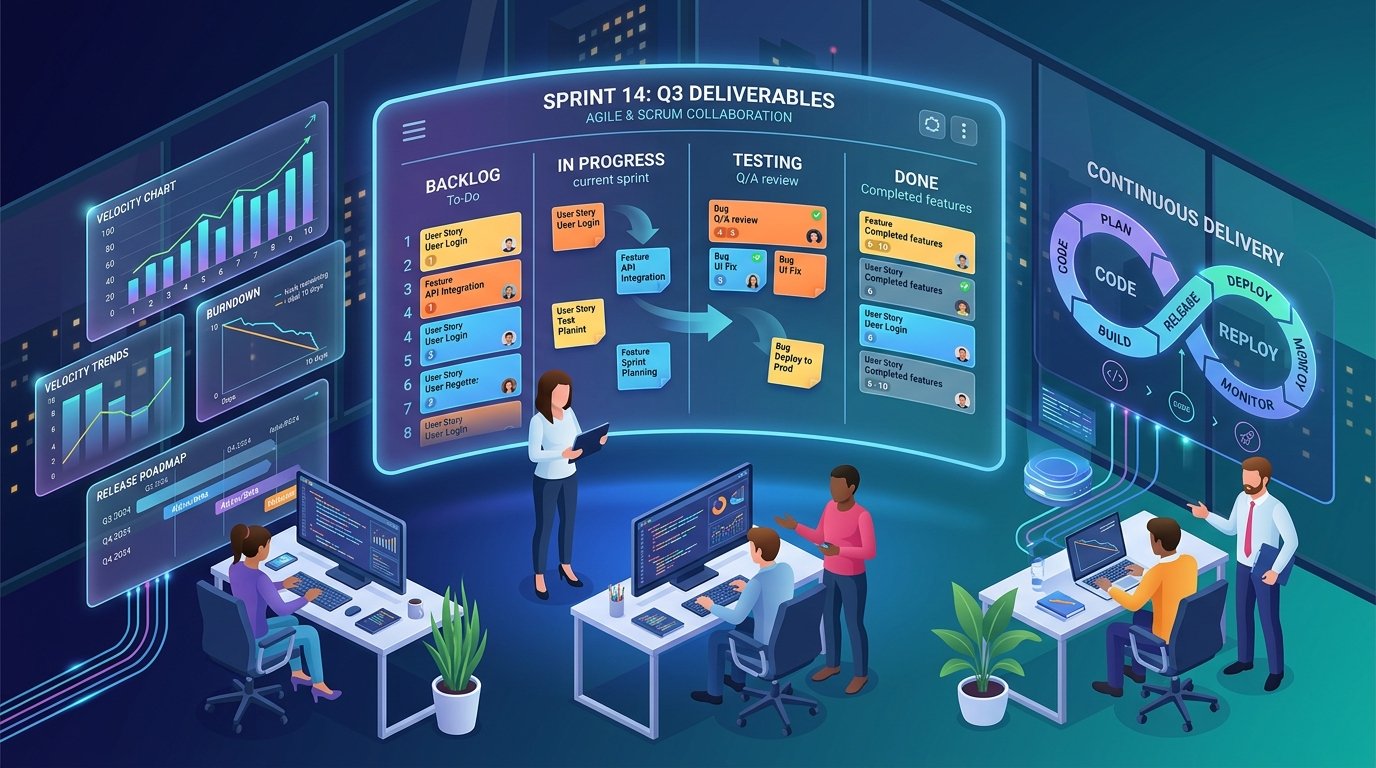
Here is the truth: Agile is the philosophy—a set of guiding values defined in the Agile Manifesto emphasizing customer collaboration, working software, and rapid adaptation to change. Scrum is the concrete framework—the prescriptive rules, roles (Product Owner, Scrum Master, Developers), ceremonies (Sprint Planning, Daily Standup, Review, Retrospective), and artifacts (Product Backlog, Sprint Backlog, Burndown Charts) used to put Agile into practice.
Software projects rarely fail due to technical incompetence; they fail due to scope creep, vague expectations, and delayed feedback loops. Understanding how to orchestrate Agile and Scrum properly is what separates chaotic projects from smooth, on-time, bug-free deployments.
 by Skylink Infosolutions™
The Core Distinctions
The Adaptive Mindset & Values
Agile is an umbrella approach that values continuous feedback over detailed documentation. It encourages teams to break work into small, digestible increments, embrace changing requirements even late in development, and inspect and adapt continuously.
The Structured Sprint Engine
Scrum organizes work into fixed-length timeboxes called Sprints (typically 2 weeks). Work committed to a sprint is locked to protect focus. At the end of each sprint, the team demonstrates a potentially shippable product increment to stakeholders.
Agile vs Scrum: Comparison Breakdown
| Facet | Agile (General Mindset) | Scrum (Specific Framework) |
|---|---|---|
| Definition | A broad software development philosophy and values | A structured, lightweight process framework under Agile |
| Roles & Responsibilities | Flexible; focuses on cross-functional team collaboration | Strictly defined: Product Owner, Scrum Master, Development Team |
| Work Cadence | Continuous flow or iterative cycles (e.g. Kanban) | Strict, fixed-length sprints (1 to 4 weeks duration) |
| Change Management | Welcomes changes at any point in the workflow | No mid-sprint changes allowed; new tasks queue in Backlog |
| Delivery Metric | Customer satisfaction and business value delivered | Sprint Velocity, Burndown Charts, Shippable Increment |
The 4 Scrum Ceremonies That Guarantee Delivery
📅 Ceremony 1: Sprint Planning & Backlog Refinement
The Product Owner presents high-priority user stories with crystal-clear acceptance criteria. Developers estimate story points using Planning Poker, ensuring zero ambiguity before a line of code is written.
⚡ Ceremony 2: Daily Standup (15-Minute Sync)
Every morning, the team addresses three vital questions: What was finished yesterday? What is the goal today? Are there any blockers? Obstacles are unblocked immediately before they cascade into delays.
👀 Ceremony 3: Sprint Review & Client Live Demo
At the end of the sprint, the team demonstrates live working features on staging environments directly to client stakeholders, collecting actionable feedback before production release.
🔄 Ceremony 4: Sprint Retrospective (Continuous Improvement)
The engineering team reviews process friction: What went well? What caused friction? How can we optimize testing or tooling for the next sprint? This drives continuous team velocity gains.
How Skylink Protects Clients From Common Project Pitfalls
🛡️ Preventing Scope Creep
We maintain a transparent Jira Kanban backlog. Any new idea or feature request is prioritized into future sprint milestones with clear budget and timeline trade-offs.
🔍 100% Client Visibility
Clients get direct access to sprint boards, burn-up charts, and automated CI/CD staging environments. You never have to wonder what your engineering team is working on.
🧪 Shift-Left QA Testing
Quality Assurance engineers write automated test cases alongside development. Bugs are caught within the same sprint rather than lingering until pre-launch crunch time.
Final Thoughts
Adopting Scrum without understanding Agile principles leads to robotic meetings and disengaged engineers. But when Agile mindset and Scrum discipline combine, software teams deliver exceptional products rapidly, reliably, and without panic.
At Skylink Infosolutions, our certified Scrum Masters and project managers orchestrate world-class software delivery pipelines. We ensure your software vision transforms into market-ready releases predictably on schedule.