 15/04/2026
AI Agents vs Automation Workflows: Understanding the Future of Intelligent Operations
Businesses today are rapidly adopting automation technologies to improve productivity, reduce manual work, and deliver faster customer experiences. Two of the most discussed technologies in this transformation are AI Agents and Automation Workflows.
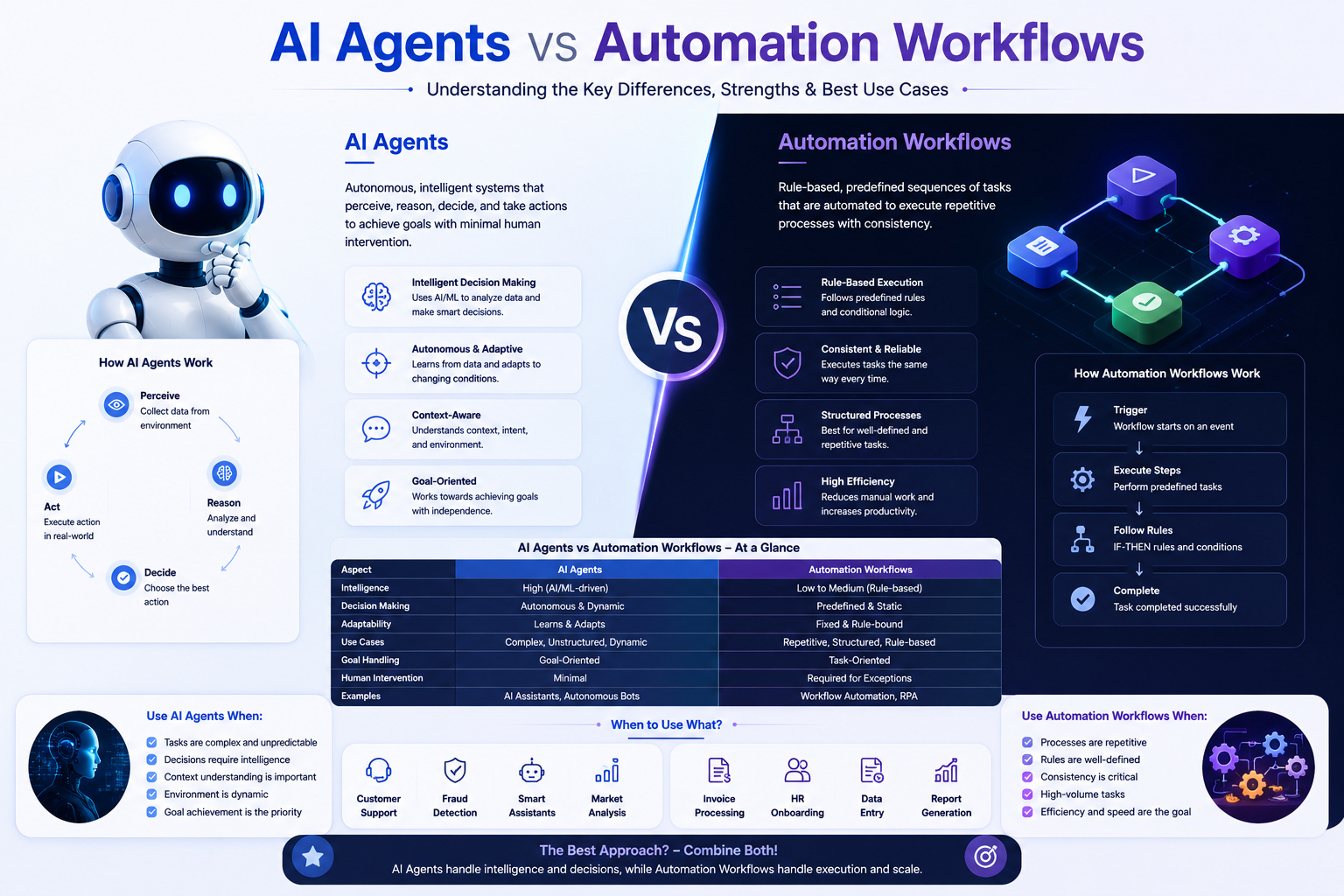
While both aim to automate processes, they work very differently. Automation workflows follow predefined rules and steps, while AI agents can make decisions, adapt to situations, and act autonomously using artificial intelligence.
Understanding the difference between these technologies helps organizations choose the right solution for scalability, efficiency, and intelligent automation.
 by Skylink Infosolutions™
What are AI Agents?
AI Agents are intelligent software systems capable of observing, reasoning, making decisions, and taking actions autonomously. Unlike traditional automation, AI agents can adapt to changing inputs, learn from interactions, and improve outcomes over time.
- 🤖 Autonomous Decision Making – AI agents analyze situations and choose actions dynamically.
- 🧠 Context Awareness – They understand user behavior, intent, and changing conditions.
- 📈 Continuous Learning – AI agents improve accuracy through data and interactions.
- ⚡ Real-Time Adaptability – They react intelligently without fixed workflows.
What are Automation Workflows?
Automation workflows are predefined sequences of tasks executed automatically based on rules and triggers. They are designed to reduce repetitive manual work and improve operational consistency.
📧 Email Automation
Automatically send emails after form submissions or customer actions.
📂 File Processing
Automatically organize, upload, or transfer files between systems.
📊 Report Generation
Generate recurring reports using scheduled workflows.
🔔 Notifications
Trigger reminders, approvals, or alerts automatically.
AI Agents vs Automation Workflows
| Aspect | AI Agents | Automation Workflows |
|---|---|---|
| Decision Making | Dynamic and intelligent | Rule-based and predefined |
| Adaptability | High adaptability | Limited flexibility |
| Learning Capability | Can learn from data | No learning capability |
| Complex Problem Solving | Excellent | Limited |
| Best Use Cases | Customer support, AI assistants, intelligent automation | Repetitive office tasks and process automation |
| Human Dependency | Lower | Higher for exceptions |
Advantages of AI Agents
Key Benefits
- Intelligent Decision Making for complex situations.
- 24/7 Autonomous Operations without constant monitoring.
- Improved Productivity through intelligent task handling.
- Scalable Automation across departments and systems.
Challenges
- Requires high-quality training data.
- Higher implementation complexity.
- AI decisions may require human oversight.
- Security and compliance considerations.
Real Business Use Cases
💬 AI Customer Support
AI agents can resolve customer queries intelligently without predefined scripts.
📑 Invoice Automation
Workflows automatically generate and send invoices on schedule.
📊 AI Analytics
AI agents analyze data trends and generate predictive insights.
The Future of Intelligent Operations
The future of automation is shifting from static workflows toward intelligent autonomous systems. Businesses are increasingly combining AI agents with workflow automation to create hybrid systems capable of adapting, learning, and optimizing operations continuously.
AI agents will play a major role in customer support, finance, compliance management, HR automation, and enterprise productivity over the coming years.
Final Thoughts
AI Agents and Automation Workflows are both powerful technologies, but they serve different purposes. Workflows are excellent for repetitive, predictable tasks, while AI agents bring intelligence, adaptability, and autonomous decision-making.
Organizations that strategically combine both technologies can build smarter, faster, and more scalable operations for the future of digital transformation.