 07/09/2026
The Evolution of Web Publishing: Breaking Free from Monolithic Constraints
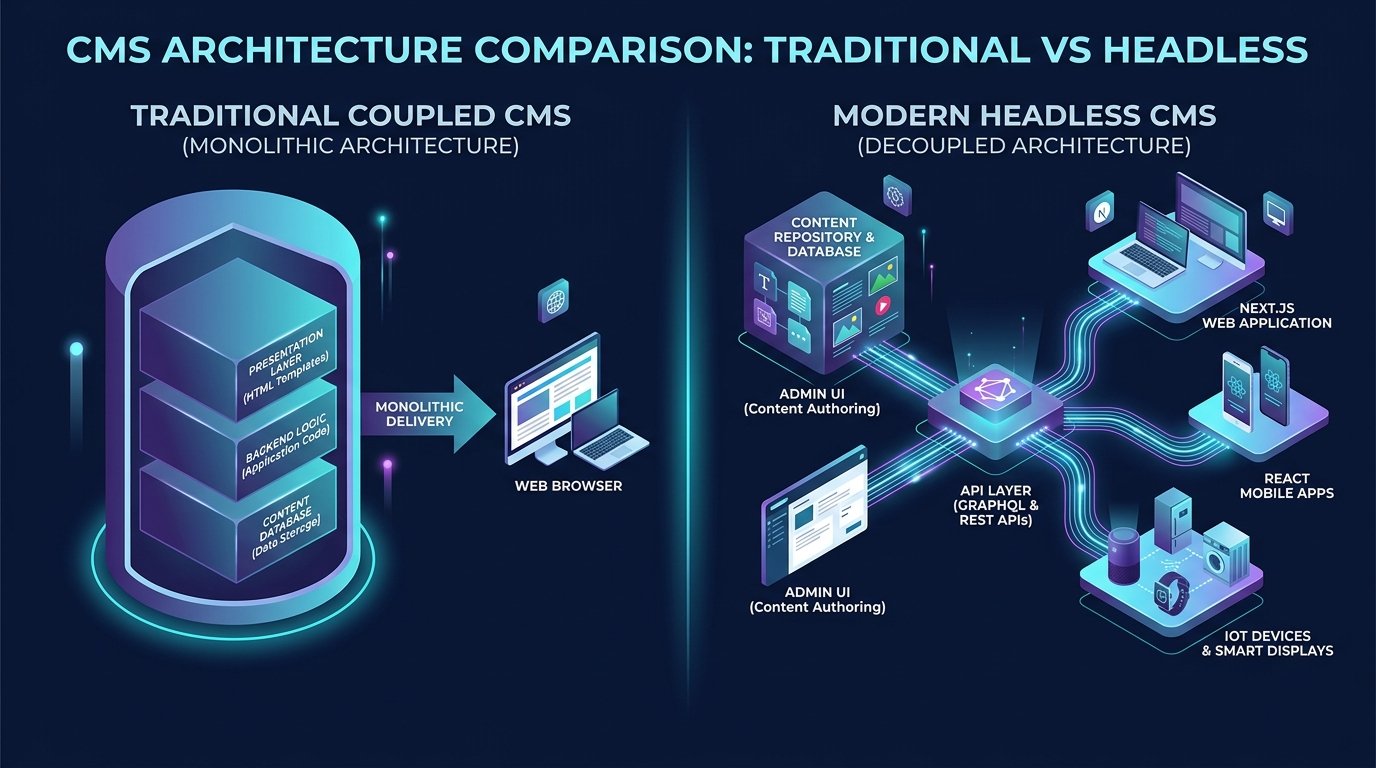
For more than two decades, traditional content management systems like WordPress, Drupal, and Joomla powered the majority of the web. These platforms coupled the backend content repository, administrative dashboard, and the frontend rendering engine (HTML/PHP templates) into a single unified monolith.
While this architecture was groundbreaking in 2005, modern digital businesses operate in an entirely different era. Content no longer lives on desktop web browsers alone. Today, brands must publish dynamic content across modern single-page web applications (React/Next.js), native iOS/Android mobile apps, digital smartwatches, in-store interactive kiosks, and smart IoT displays.
Enter Headless CMS. By completely severing the frontend "head" from the backend "body", headless architecture treats content purely as structured data accessible through blazing-fast APIs (GraphQL or REST), revolutionizing speed, security, and developer agility.
 by Skylink Infosolutions™
Understanding the Two Models
All-In-One Monolithic Structure
The database, content creation UI, and frontend website theme are tightly glued together. When a visitor requests a page, the server queries the database, executes PHP/Ruby code, and renders the complete HTML on the fly. Heavy plugins and themes often lead to sluggish load times and security vulnerabilities.
API-First Content Repository
A pure backend content management hub (like Strapi, Sanity, or Contentful). Content creators write copy and upload assets in an intuitive interface, while frontend developers have complete freedom to build ultra-fast user experiences using Next.js, Nuxt, or mobile frameworks that fetch content via GraphQL/REST.
Headless CMS vs Traditional CMS Comparison
| Feature Dimension | Traditional CMS (e.g. Classic WordPress) | Headless CMS (e.g. Strapi, Sanity + Next.js) |
|---|---|---|
| Frontend Flexibility | Restricted to CMS theme engines and template languages (PHP) | Unlimited: React, Next.js, Vue, Flutter, SwiftUI, or Svelte |
| Page Speed & Core Web Vitals | Often slow due to plugin bloat, database lookups, and DOM overhead | Blazing fast: Static Site Generation (SSG) & Edge CDN caching (99+ score) |
| Cybersecurity Posture | High attack surface (SQL injection, plugin exploits, wp-login attacks) | Extremely secure: Frontend is decoupled; database is never exposed to visitors |
| Omnichannel Distribution | Single website channel only; difficult to feed mobile apps | One central content hub feeds Website, Mobile App, Kiosks & Smart Devices |
| Scalability Under Traffic Spikes | Requires heavy caching plugins, load balancers, and beefy database servers | Virtually infinite: Static pages served directly from global Edge CDNs (Vercel, Cloudflare) |
Why Enterprise Brands Are Migrating to Headless
⚡ 1. Sub-Second Page Speeds Boost Conversions
With Next.js Incremental Static Regeneration (ISR), pages are pre-rendered into static HTML at build time and cached worldwide on edge networks. Visitors experience instant zero-latency clicks, resulting in dramatic conversion rate surges and higher Google rankings.
🔒 2. Enterprise-Grade Security & Zero Vulnerabilities
Because there is no administrative login URL or database connected to your public-facing frontend website, DDoS and SQL injection vectors are virtually eliminated, drastically reducing cybersecurity risks.
📱 3. True "Create Once, Publish Everywhere" (COPE)
Your marketing team creates a new product announcement or case study once in your headless dashboard. It instantly populates your responsive web portal, mobile app notifications, and client portal simultaneously.
🛠️ 4. Future-Proof Technology Stack
Redesigning your brand identity in the future does not require migrating your content database. Your developers simply replace the frontend presentation layer while your entire content repository remains untouched.
Which Approach Suits Your Business?
Traditional CMS is Sufficient If:
- You run a simple personal blog or small local business website with modest traffic.
- You have zero in-house developer support and rely entirely on pre-built off-the-shelf themes.
- You do not have a mobile app or omnichannel publishing ambitions.
- Your budget is limited to cheap shared hosting setups.
Headless CMS is the Clear Choice If:
- You want peak Google PageSpeed Insights scores (95+) to outperform search competitors.
- You distribute content across both web applications and native iOS/Android mobile apps.
- You need ironclad security without worrying about plugin patch vulnerabilities.
- You want a modern, scalable digital architecture that grows seamlessly with your business.
Final Thoughts
Headless CMS architecture represents the modern standard for fast, secure, and multi-channel digital experiences. While traditional CMS platforms still hold a place for basic websites, ambitious businesses aiming for high search rankings and frictionless omnichannel user journeys are rapidly decoupling their stacks.
At Skylink Infosolutions, our CMS engineers specialize in building enterprise headless solutions using Next.js, React, Strapi, Sanity, Contentful, and headless Shopify. We deliver lightning-fast digital storefronts and publishing engines engineered for growth.